R&D and product engineering
Most projects reach us as a sketch, a problem or a half-working prototype. We work out what the product must do, what it can cost and what could stop it, then build the riskiest parts first. Computer vision, AI and simulation come in when the problem needs them.
AI proofs of concept
Before you commit to a full product, we test whether AI can solve the problem on real data, and tell you plainly if it can't.
See AI integration- Feasibility on your own data
- Vision, sensor and language models
- Clear go or no-go
What we do
Turn an idea into a working prototype, and a plan for building it.
Feasibility and requirements
We test the idea against physics, cost and schedule before money goes into tooling: sensor choices, power budget, BOM cost targets and a risk list.
- Requirements
- BOM costing
- Risk review
System architecture
How hardware, firmware, apps and cloud share the work: block diagrams, interfaces, protocols and the choice of microcontroller or processor.
- Block diagrams
- Protocols
- MCU and MPU selection
Proofs of concept and prototypes
Dev-kit proofs first, then custom boards and enclosures, built and brought up on our own bench.
- Rapid prototyping
- Board bring-up
- Enclosures
Computer vision and 3D
OpenCV pipelines, YOLO detection, point clouds and depth cameras for inspection and measurement, running on Jetson, Raspberry Pi or a PC.
- OpenCV
- YOLO
- PCL and Open3D
- Depth cameras
AI and simulation
Local AI models, digital twins and simulators that let you test logic and processes before you touch the hardware.
- Local AI
- Digital twins
- Simulation
Compliance preparation
Design rules and documentation aimed at CE, FCC and RoHS from the first schematic. Testing itself happens at accredited labs, which we coordinate.
- CE
- FCC
- RoHS
How a project runs
- 01
Discovery
Goals, constraints, users and the environment the product will live in, written down and agreed before design starts.
- Requirements document
- Risk list
- 02
Feasibility
The hard questions answered with calculations, simulation or quick bench tests.
- Feasibility report
- BOM estimate
- 03
Architecture
The system split across hardware, firmware, apps and cloud, with key parts selected.
- Block diagram
- Interface specification
- 04
Proof of concept
The riskiest part built first on development kits, so surprises show up early and cheaply.
- Working proof of concept
- Test data
- 05
Prototype
Custom PCB, firmware and app working together, first on the bench and then in the field.
- Prototype units
- Test report
- 06
Plan for production
What it will take to finish the design and build it: scope, budget and timeline.
- Development roadmap
- Production plan
What you receive
Everything is yours at handover, including the source and its history.
Requirements document
What the product must do, agreed and signed off.
Feasibility report
Calculations, test results and the risks that remain.
System architecture
Block diagrams, interfaces and part choices.
BOM cost estimate
Bill of materials with prices at your target volumes.
Working prototype
Hardware, firmware and software you can hold and test.
Test report
Bench and field results against the requirements.
Design files and source
Everything we made, with full version history.
Production roadmap
The path from prototype to a product you can sell.
Tools we use
Vision and analysis
Python and OpenCV
Image processing, measurement and data analysis.
Model training
PyTorch and TensorFlow
Detection, classification and segmentation models.
3D processing
PCL and Open3D
Point clouds from depth cameras, structured light and LiDAR.
Edge deployment
Jetson and Raspberry Pi
Models optimised with TensorRT, TFLite or ONNX Runtime.
Circuit simulation
LTspice
Power, filter and analogue checks before layout.
Robot perception
ROS 2
Camera and LiDAR pipelines for robots and AGVs.
Related work
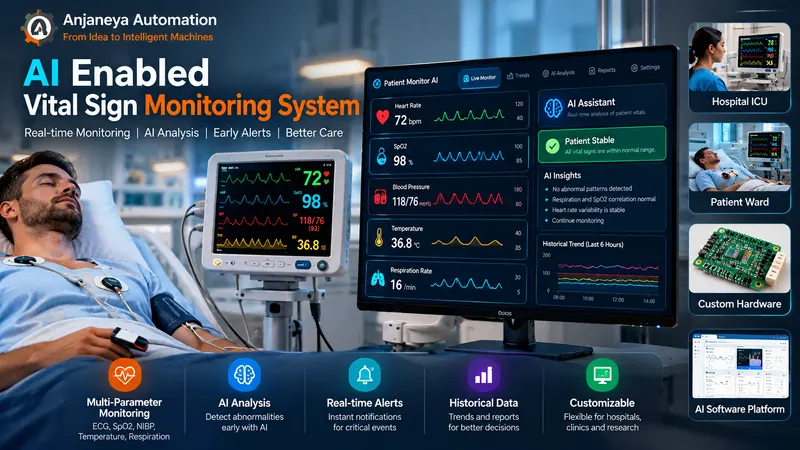
Contactless vital-signs monitoring
A 60 GHz radar and a thermal camera measure heart rate, breathing and temperature without touching the patient, shown on a branded touch-screen kiosk.
Read the case study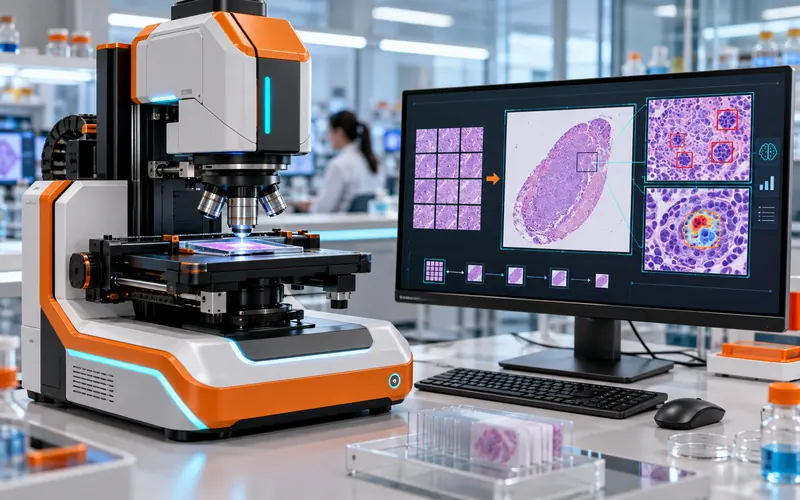 AI inside
A lab microscope turned into an AI slide scanner
We added X, Y and Z axes to a lab microscope so it captures a whole slide tile by tile and stitches it into one image. Our AI software then flags suspected cancer cells, using the settings the doctor or lab technician chooses.
Read the case study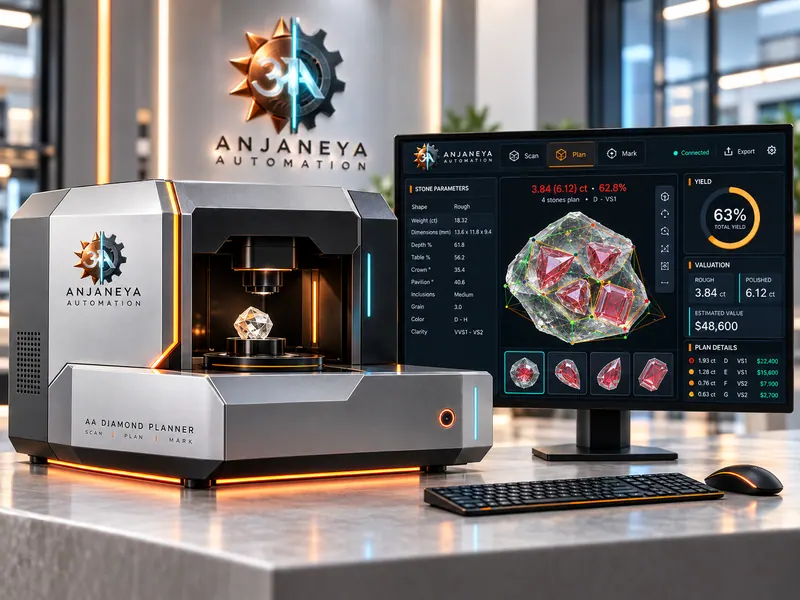
The Diamond Planner machine, designed end to end
A machine that scans a rough diamond in 3D and plans the most valuable stones inside it, using our own gravity-based optimization. We designed all of it: the mechanics, the 6-axis controller board and the software.
Read the case studyReady to make your machine smarter?
Tell us about the machine you run or the product you imagine. We reply within 24 hours on working days. We sign an NDA before you share details.